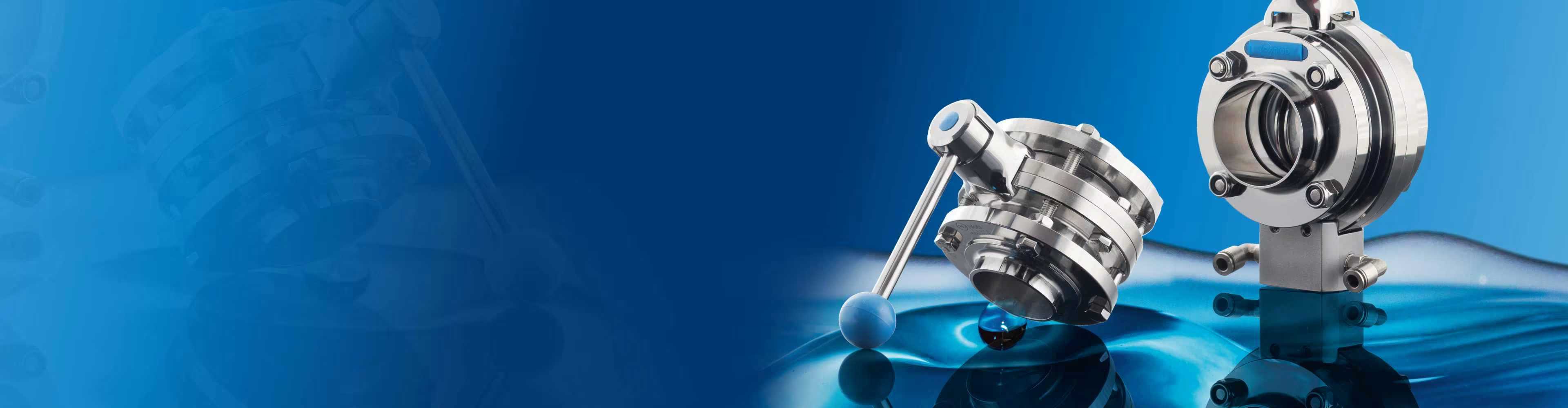
04. Regulating valves
Regulating valves are designed for closing and regulating the flow in the pipeline. The most used in the food industry is the Butterfly valve. It is available in many connection options. The standard control is manual, and other control options are: control with a horizontal or vertical pneumatic actuator, or 24V, 230V electric actuators can be used. Silicone is used as the standard seal, it can also be equipped with Viton, EPDM, NBR seals.
Ball valve is a shut-off valve suitable for flow regulation, the shut-off ball is placed in Teflon seats and when fully opened, the valve is full-flow. The PTFE seal allows use up to 150°C. Three-way ball valves can have an inner ball with a “T” or “L” bore
PNEUMATIC ACTUATORS FOR CONTROLLING DAMPERS AND BALL VALVES
Pneumatic actuators are divided into horizontal and vertical and are available in two versions:
• Single-acting - (air/spring) this type offers a so-called safety function by its design, when the control air pressure drops or the electrical power supply to the solenoid is interrupted, the damper automatically closes
• Double-acting - (air/air) adjustment to both positions is ensured by compressed air
• The working pressure for the correct function of pneumatic actuators is 5-6 bar. Connection to the compressed air distribution is standardly solved by 6/4 mm hose distribution.
• Pneumatic actuators can be equipped with a control solenoid valve, which uses an electromagnet to control the opening and closing of the damper
• Pneumatic actuators can be equipped with several variants of position signaling, or a control head that includes electronic and visual position signaling and a solenoid valve for controlling the actuator.
ELECTRIC ACTUATORS - FOR CONTROLLING DAMPERS AND BALL VALVES
Electric actuators use an electric motor for closing, which closes the heart of the damper (the ball of the ball valve) through gears. In the event of an interruption in the power supply, the actuator can be controlled manually.
Electric actuators are supplied according to the required damper size. The actuators are usually equipped with limit switches and end position signaling. The time required to close the electric actuator is 14 - 21 seconds for standard electric actuators.
Divert valves are designed for regulating and closing pipelines, they are mainly supplied with pneumatic actuators and are installed in control units for regulating more complex pipelines. These come in a single or double seat version with many modifications for regulating flow direction.